For SaaS, Web Platforms & Digital Products
Digital Product Design Services
End-to-end digital product design services focused on usability, scalability, and measurable growth. From research to launch-ready assets.
↳ What you’ll get?
↳ Is this for you?
You're planning, rebuilding, or scaling a digital product, and you need design that earns its keep. A few situations we hear most often:
- You have a working product but adoption has plateaued, and you suspect the experience is the bottleneck.
- You're launching something new — SaaS, a web platform, a marketplace — and need a launch-ready design system, not just screens.
- You raised, and investors expect a product that looks and feels as serious as the pitch deck.
- Engineering keeps shipping, but features get buried, support tickets climb, and conversion stays flat.
- You've worked with freelancers or generalist agencies before and the work didn't survive contact with real users.
- You're a non-design founder making design calls you shouldn't have to make, and you want a partner who owns the outcome.
If two or more sound familiar, a call is probably worth your 30 minutes.
Book a free call →

What is digital product design?
Digital product design is the discipline of shaping how a software product looks, behaves, and earns its place in a user's day. It combines product strategy, user research, interaction design, UI design, and design-system thinking into one workflow — so that every screen, state, and flow connects to a business outcome: activation, retention, conversion, or revenue. It's not visual polish on top of a feature list. It's the structural work that decides whether the product gets used.
↳ About service
Our digital product design services cover the full arc of building a software product — from the first research call to a development-ready handoff your engineers can build from on day one. The work is design-driven and science-led: every decision is grounded in research, validated against user behavior, and tied to a measurable business goal.
We start with discovery. Before a single screen is drawn, we map your market, study your competitors, talk to your users, and pressure-test the assumptions baked into the brief. This is where most product investments quietly fail — the wrong problem, framed confidently.
Our discovery phase produces a competitive analysis, user research synthesis, and a written problem statement that the rest of the project can be measured against.
From there, we move into structure. Information architecture, user flow diagrams, and low-fidelity wireframes — the load-bearing layer of the product.
As a new product design service, this is where we earn our keep: getting the skeleton right is cheaper than fixing it in code six months later. We work in tight cycles with founders and product leads, so nothing gets locked in without your eyes on it.
Then comes the visible layer — UX product design services in the literal sense. Interaction design, UI design, and the assembly of a working design system. We design states, not just screens: empty states, error states, loading states, multi-role views, edge cases. Every component goes into a UI Kit that scales with the product instead of fighting it.
Finally, handoff. A hand-off package built for developers, not designers: structured Figma files, documented design tokens, component specs, and the conventions your engineering team needs to ship without guesswork.
If you want the design work to plug directly into a build phase, this page lives inside a broader digital product design and development services offering — design here, build separately, both built to fit together.
Across all of this, we work as an embedded team rather than a vendor. Your core squad is a Product Designer, a Strategic Lead, and a Project Manager, with specialists — researcher, motion designer, design-system engineer — added as the work demands.
Engagements run from a few focused weeks to multi-year partnerships, scoped to what the product actually needs.
↳ Signs you need this service
Each of these is a symptom. The line after is what changes when the design work is done right.
- Low feature adoption. New releases don't move the metrics they were meant to move.
→ A research-led design process that ties every feature to a user job and a success metric, so adoption is designed in, not hoped for. - Complicated user flows. Users get stuck, support tickets repeat the same three questions.
→ Flow-level redesigns built around the actual paths users take, with friction removed where it costs you conversions. - Multi-role complexity. Admins, end users, and managers all crammed into the same UI.
→ Role-aware interfaces that show each user only what they need, in the right hierarchy. - Design that doesn't survive engineering. The Figma file looks great; the shipped product doesn't.
→ A handoff package and design-system contract that gives engineering everything they need to ship the design as designed. - Investor-grade gap. The product works, but it doesn't look like the company you're trying to become.
→ A UI layer and visual system that match the ambition of the round you just raised.
↳ Solutions for every industry
FinTech design services. Banking, credit unions, lending, payments, and analytics platforms. The bar is trust before transaction — interfaces have to feel safe before they feel useful. We design for regulated environments where every interaction carries weight, balancing compliance requirements with the clarity users actually need to move money with confidence.
Designing and building AI products and services. Translating model output into something a non-technical user trusts and acts on. We design the surface layer of AI products — prompt interfaces, agentic workflows, confidence states, fallback paths — so the intelligence inside reaches the user without friction. The hard problem in AI design isn't novelty; it's making a probabilistic system feel predictable.
HealthTech & MedTech. Patient-facing tools, clinician dashboards, diagnostics, and care platforms. Workflows have zero tolerance for ambiguity, and the design has to clear regulatory review while staying humane. We design for the moments where clarity isn't a preference — it's clinical.
HR Tech & Recruiting. ATS platforms, talent marketplaces, internal HR tools, and assessment products. Multi-sided design problems — recruiters, candidates, hiring managers, admins — each with a different definition of "done." We design the seams between those roles so the product feels coherent regardless of which side you're on.
↳ Why work with us
Design-driven, science-led. Every decision is grounded in research and validated against user behavior — not preference, not trend, not whichever screenshot looked good on Dribbble this week.
CSAT
Customer Satisfaction Score (CSAT) in Tech, Luxury & Business Services
Projects Delivered
Complex digital products delivered on time across FinTech, Healthcare, Hospitality, and Business Services.
Rating & Review
Trusted rating based on verified client reviews on Clutch
Have a project to discuss?
Book a free 30-minute call with our CEO. We'll review your situation and tell you honestly whether we're the right fit.


↳ Workflow

Discovery Phase
We define product goals, user needs, core flows, technical constraints, business priorities, and UX opportunities to create a clear foundation for design decisions.

Design Phase
We translate product logic into wireframes, high-fidelity UI, interactive prototypes, and reusable components that support consistency and scalability.

Hand-Off
We prepare structured Figma files, design specifications, assets, component states, and interaction notes so the development team can build with fewer gaps and rework.
How we turn services into results
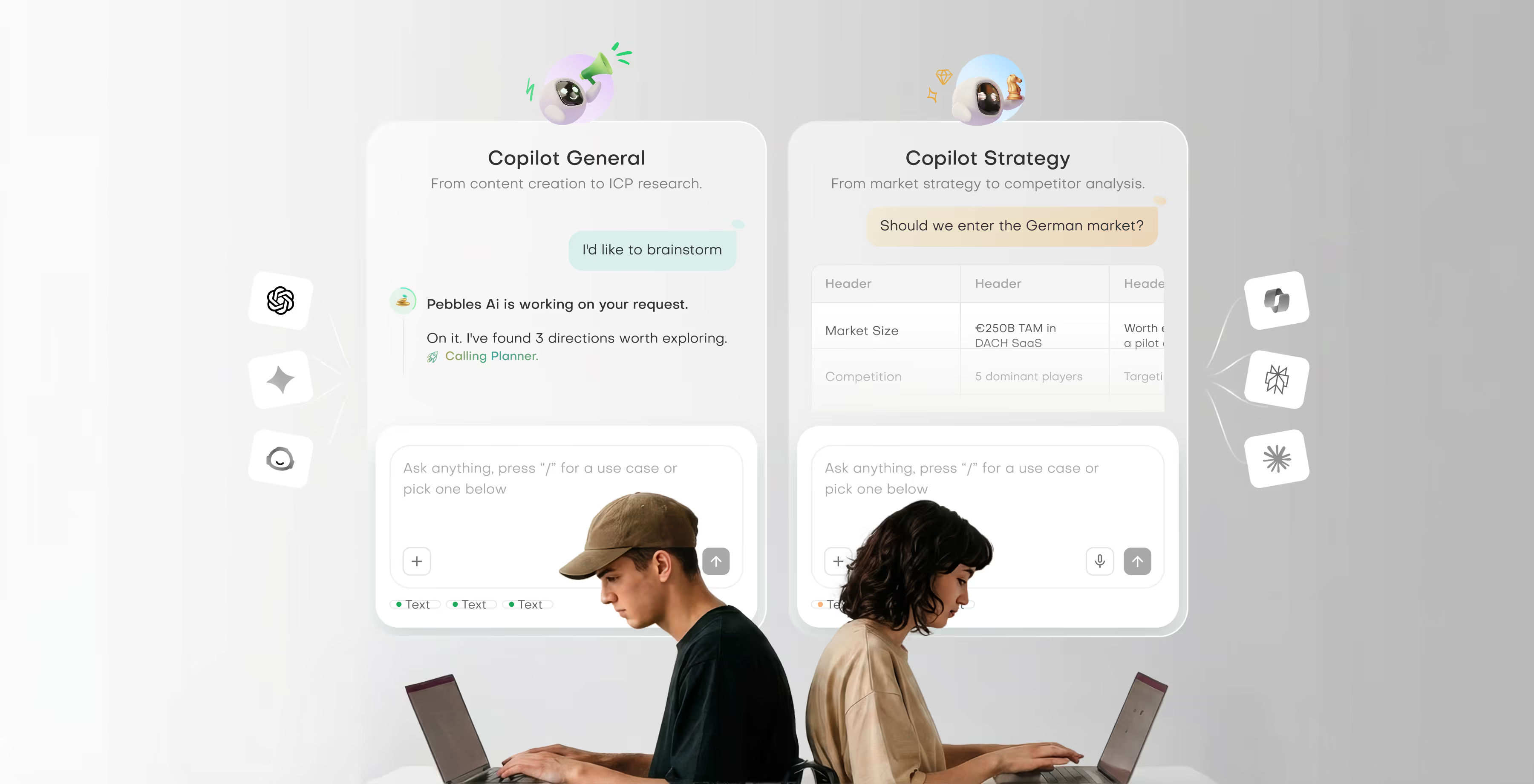

Looking to create a stronger digital presence? Let’s chat!
What our clients say about working with us


.svg)
.avif)


.svg)

.svg)