You can picture your product clearly. You know what it should do, who it's for, and why it will work. Then you explain it to a developer or a team, the build begins, and what comes back is almost right — but almost right is expensive to fix.
The Gap Nobody Talks About: From Idea to Buildable Product
Most founders assume the hard part of building a digital product is the building itself. In practice, the bigger risk sits earlier, in the space between an idea and a clear brief a team can act on.
Here's the uncomfortable truth backed by decades of software research. The cost to fix a problem rises sharply the later it's caught. Research from the IBM Systems Sciences Institute found that a defect fixed during testing costs roughly 15 times more than one caught during design, and a problem found after release can cost up to 100 times more. Industry analysis goes further: it attributes as much as 64 percent of total defect costs to errors made in the requirements and design phases.
Read that again. The most expensive mistakes aren't coding mistakes. They're decisions made — or skipped — before anyone writes code.
When you hand an unvalidated idea to a development team, you're not giving them a starting point. You're giving them a set of assumptions they'll quietly fill in with guesses. Every guess is a small bet, and you only discover the bad bets after they've been built. Concept design exists to replace those guesses with deliberate decisions while changes are still cheap.
What Creative Concept Design Actually Is (And What It Isn't)
Creative concept design is the phase where a product idea is shaped into a clear, communicable, buildable vision. It defines what the product is, who it serves, how it should feel, and what it needs to do — before a single screen is finalised or a line of code is written.
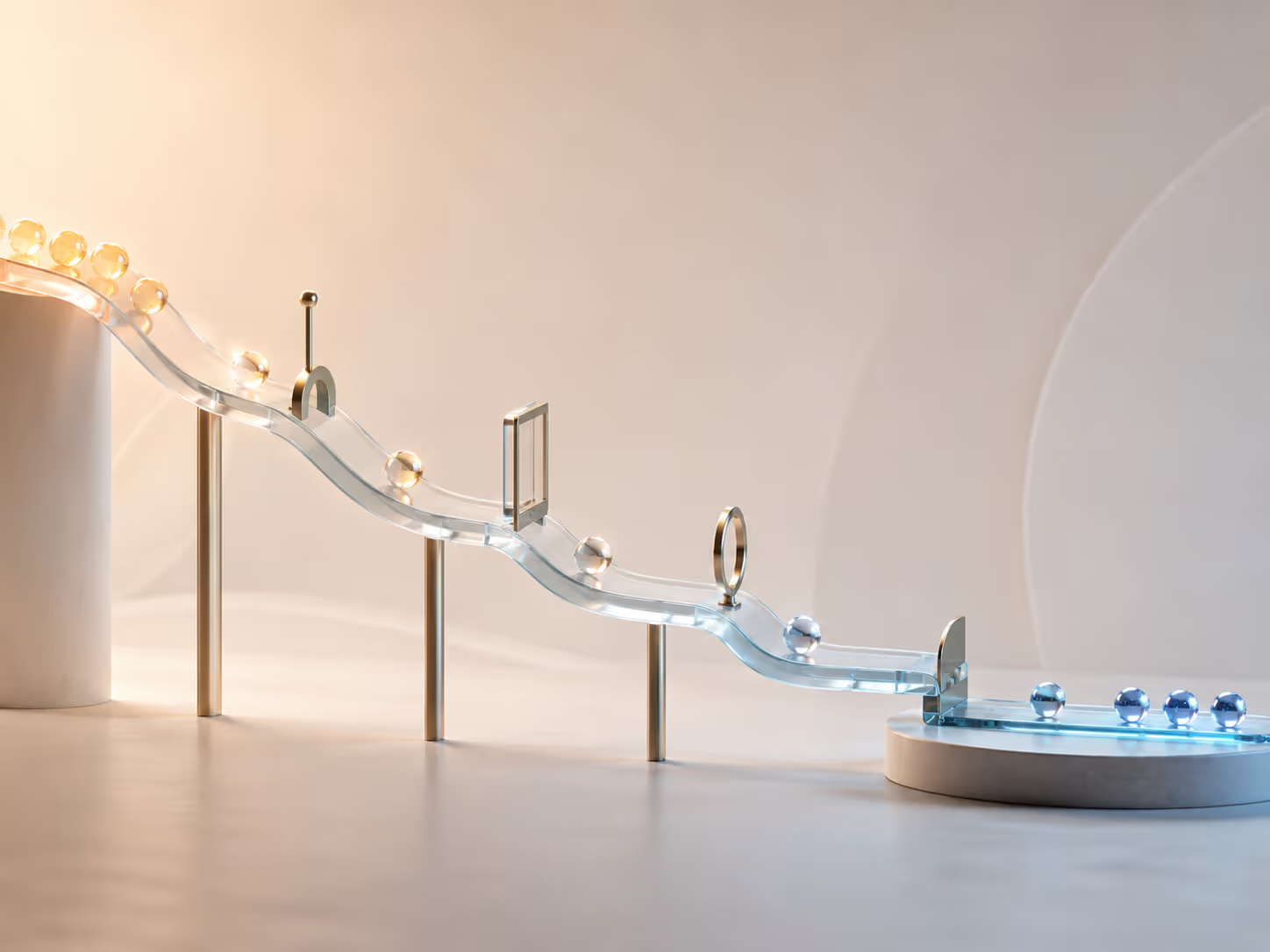
Think of it as the bridge between your head and your team's hands. It takes the version of the product that lives in your imagination and turns it into something specific enough to build, pitch, and align around.
It helps to be precise here, because a few terms get tangled together. Digital product concept design is not the same as wireframing, which maps the layout of individual screens. It's not prototyping, which tests a working model of a feature. And it's not the same as building a minimum viable product, which is an early version released to real users. Concept design sits before all of these. It sets the direction those later stages execute against.
A useful way to frame it: wireframes answer "where does this button go?" Concept design answers "what are we actually building, for whom, and why will it work?" Get the second question right and the first becomes far easier.
How to Develop Design Concepts: What the Process Looks Like
So how to develop design concepts in practice? A strong concept design process moves through a few clear stages. Understanding them helps you know what to contribute and what to expect in return.
It usually starts with intake and problem framing. This is where your idea, your market knowledge, and your goals are unpacked and pressure-tested. The aim is to separate what you know from what you're assuming, and to define the real problem the product solves. A vague problem produces a vague product.
Next comes conceptual direction. Here the core idea is translated into a coherent product vision: the key user journeys, the central value the product delivers, and the decisions that shape everything downstream. This is where competing approaches are explored and narrowed to one clear direction.
Then comes visual and experiential language — the look, feel, and tone of the product. Not pixel-perfect screens, but the design thinking that defines how the product should be experienced and what makes it distinct.
Finally, the work is shaped into handoff-ready output: a vision clear enough that a development team, an investor, or a new hire can understand exactly what's being built and why. This is the point where concept design connects directly to delivery. If you want to see how that direction carries into a working product, it flows naturally into digital product design and the build that follows.
Your role throughout is to bring context and make decisions, not to design. The process is built to draw out what you know and turn it into something concrete.
What a Strong Design Concept Contains
A common question from founders is what a finished concept actually looks like. Asking for a sample of design concept is reasonable — you want to know what you're paying for. The honest answer is that the output is less a single artifact and more a connected set of decisions you can act on.
A strong concept typically gives you a clear articulation of the product vision in plain language, the primary user journeys mapped end to end, the core feature direction with priorities made explicit, and a defined visual and experiential direction. Together these answer the questions a team would otherwise have to guess at.
What makes the output valuable is not how it looks but what it removes: ambiguity. A good concept means your developer isn't inventing logic on your behalf. Your investor isn't squinting to understand the vision. Your next hire isn't asking what the product is supposed to be. Everyone is working from the same clear picture.
That clarity also has a second life. The same concept that guides your build often becomes the backbone of an investor deck or a product roadmap. You define the vision once, then reuse it everywhere it needs to be communicated.
When You Need Creative Concept Design — and When You Don't
Not every project needs a full concept phase, and it builds more trust to say so plainly. Here's a simple way to judge where you stand.
You almost certainly need creative concept design if you're building a digital product for the first time, if the user journey is complex or non-obvious, or if you'll be raising money or aligning multiple stakeholders. In these cases the cost of misalignment is high, and a clear concept pays for itself many times over by preventing expensive rework later.
A lighter discovery phase may be enough if you already have a working product and are extending it, or if the idea is small and self-contained with a well-understood user flow. Here the risk of building the wrong thing is lower, so a leaner process makes sense. If that sounds closer to your situation, early-stage discovery design is often the right entry point.
And occasionally you're simply too early. If you can't yet describe who the product is for or what core problem it solves, no amount of design will fix that. The honest next step is sharpening the idea itself before shaping it into a concept.
The point isn't to push every founder toward the heaviest process. It's to match the depth of work to the real level of risk.
What to Look for in a Concept Design Partner
If you decide you need help, knowing how to evaluate a partner matters as much as the work itself. A few practical criteria separate a strong partner from a weak one.
Look for a partner that interrogates your idea before agreeing with it. The most valuable concept work involves honest pushback, not flattery. Ask what you'll actually walk away with, and expect a clear answer in plain language rather than vague promises of "deliverables." A partner that speaks to you like a founder, not like a fellow designer, is one that understands its job is to make you confident, not dependent.
Pay attention to how a partner uses AI as well. Used well, AI is leverage — it lets a team explore more conceptual directions faster, test more variations of a vision, and move from idea to clarity in less time. The value still comes from the thinking and judgement behind the work. AI should expand what a small team can explore, not replace the strategic decisions that only experienced people can make. A partner that treats AI-assisted design as a way to do better thinking faster, rather than a shortcut around it, is one worth your attention.
The red flags are the inverse of all this: a partner who agrees with everything, can't explain what you'll receive, or rushes to screens before understanding the problem.
Turning Your Idea Into Something You Can Build
A great product idea is worth very little until it has a clear, communicable, buildable shape. That gap is exactly where most early ventures stall — not because the idea was weak, but because it was never translated into something a team could execute with confidence.
If you're sitting on a product idea that doesn't yet have a defined shape, that's not a sign you're behind. It's the precise starting point that creative concept design is built for. The goal isn't to slow you down with process. It's to make sure the thing you build is the thing you actually meant to build — before it gets expensive to change your mind.
The most useful next step is simply to get honest about how clearly your idea is defined today. If you can describe the problem, the user, and the value in a few clear sentences, you're closer than you think. If you can't yet, that clarity is what concept design is designed to give you.


.svg)