Validate Before You Build
Product Prototyping Services
Product prototyping services to validate ideas, test flows, and align stakeholders before full-scale development.
↳ What you’ll get?
↳ Is this for you?
You have an idea, a product direction, or a rebuild in progress — and you need to know it works before committing budget to full development. A few situations we hear most often:
- You have a technical concept but no way to show that the core mechanic actually works at a product level — and no one will sign off without seeing it
- You're building on a new technology — an AI model, a hardware integration, an unusual data architecture — and you need to validate the approach before committing to a full build
- You've already been through one development cycle that had to be reversed. The cost was significant and you're not willing to repeat it
- A partner, investor, or internal stakeholder needs a working proof of concept before they'll approve the next stage
- You need to move fast — you have a launch window, a funding milestone, or a client deadline — and you can't afford to start building in the wrong direction
If two or more sound familiar, a call is probably worth your 30 minutes.

How do you go from prototype to production?
Product prototyping services bridge the gap between an idea and a development-ready specification. A functional prototype proves the core mechanics work — the logic, the data flows, the decision paths — before engineering commits to a full build. Once tested and validated, it becomes the specification your team builds from: less ambiguity, fewer mid-build reversals, and a shorter path from first commit to a working product. The risk you eliminate at prototype stage is the most expensive kind to fix later.
↳ About service
Product prototyping services exist to reduce the risk that sits between an idea and a live product. By the time most teams realise their product direction had a fundamental flaw, they've already spent months and significant budget in development. Prototyping removes that risk by making your product experience testable, reviewable, and refineable before production begins.
We build a functional prototype product — typically high-fidelity enough to be tested with real users or presented to stakeholders, but scoped to focus on the flows and decisions that carry the most business risk. Every screen and interaction is built around specific user jobs and business outcomes: activation, conversion, task completion, or trust. Nothing is included for visual effect alone.
Where technical risk is high, we run validation testing against the prototype — checking that the core logic holds, that edge cases are handled, and that the system behaves as expected under realistic conditions. Findings feed directly into a refinement cycle before anything is handed to the engineering team.
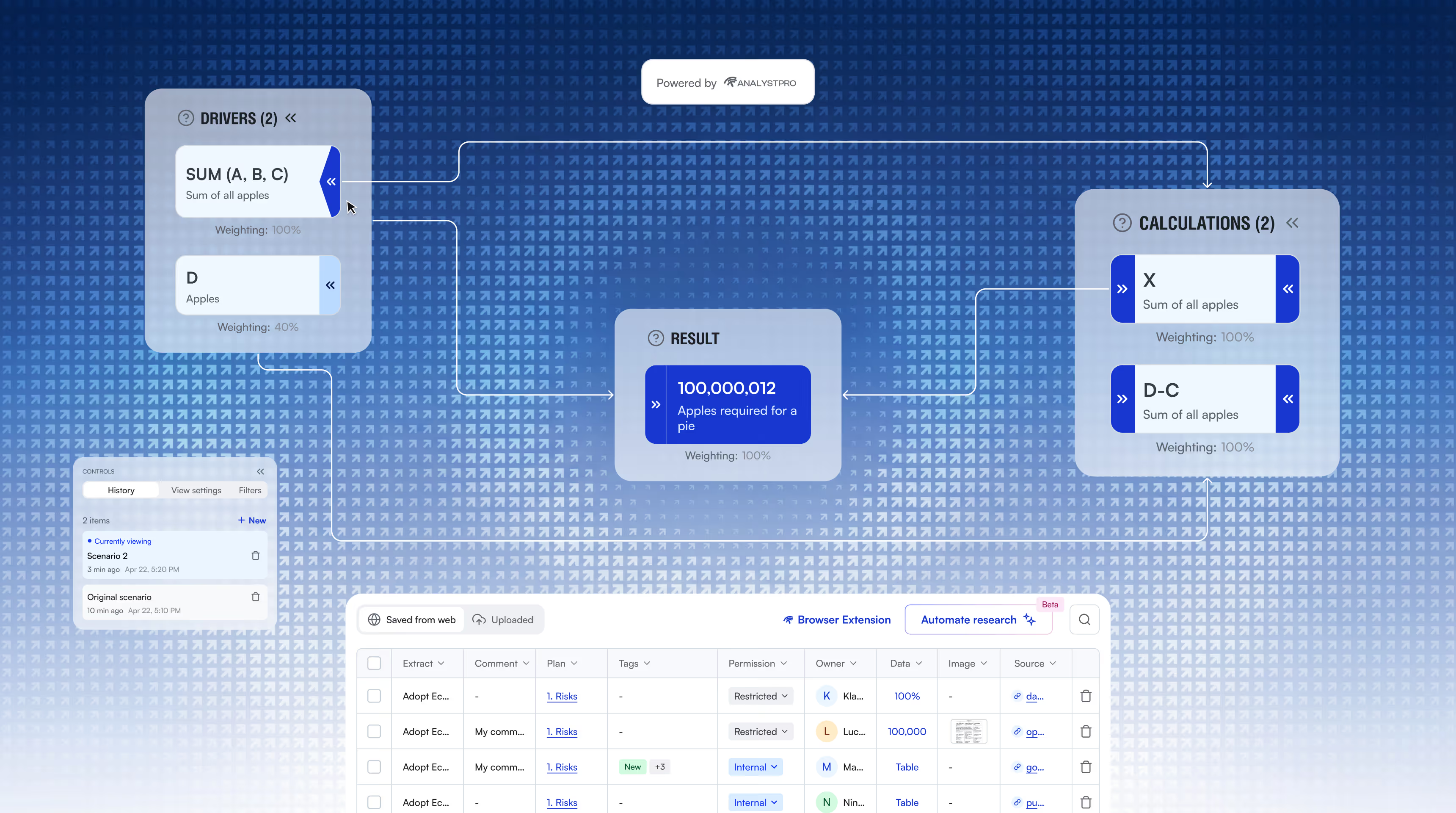
It demonstrates how the system behaves, what data it needs, and how the logic flows from input to outcome. This is where [prototype to production] development becomes a structured handoff rather than a guessing game. Engineering receives a working model, not an interpretation — with fewer assumptions to make and a more direct path to a production build.
We also support digital product prototyping for AI-powered product experiences, where the challenge is not just interaction design but communicating model behaviour, confidence levels, and decision logic in a way a non-technical user can trust and act on.
The core squad on a [product prototype development] engagement typically includes an Engineer or Technical Lead, a Strategic Lead, and a Project Manager, with specialists added based on scope — for instance, a backend engineer for API or data integration work, a solutions architect for complex system dependencies, or a domain specialist where regulatory or industry constraints apply.
Engagements typically run from one to several weeks, scoped around what the product or business actually needs. A standalone prototype for a single critical flow is a valid scope. So is a phased engagement that moves from prototype through to full product development and growth optimisation.
↳ Signs you need this service
Each of these is a symptom. The line after is what changes when the work is done right.
- Development started, then reversed. You've built something, tested it with users or the market, and had to go back to fundamentals. The cost was significant.
→ A validated prototype surfaces those fundamental issues in days, not months, so the course correction happens before production budget is spent. - No shared definition of what the product should do. Your team, your engineers, and your stakeholders are operating on different assumptions about system behaviour, scope, and functionality — and those gaps won't surface until the build is already underway.
→ A functional prototype creates a single testable reference point that replaces assumption with observable system behaviour, so misalignments are resolved before they cost development time. - A core concept is still unvalidated. You're preparing to invest significant development resources into a product, but a key assumption — technical, functional, or commercial — hasn't been tested against real conditions.
→ A focused prototype isolates and validates the riskiest assumptions first, so the full development cycle begins with evidence rather than optimism. - You're going into development without confidence. The brief to your engineering team is still abstract. You're not sure they have enough to build the right thing.
→ A prototype with annotated flows and interaction specifications gives engineering a precise build target, reducing handoff losses and mid-build revisions. - You've pitched the product but couldn't demonstrate it. Investors, partners, or leadership want to see the product work — not hear about it.
→ A high-fidelity, interactive prototype makes the product experience tangible, credible, and demonstrable before a single line of production code is written.
↳ Solutions for every industry
AI product prototyping. Building an AI-powered product introduces a layer of technical uncertainty that only a functional prototype can resolve before full development begins. How does the model respond under varied inputs? How does the system handle edge cases, low-confidence outputs, or missing data? What does the integration between model, product logic, and data source actually look like under realistic conditions? We build functional proof-of-concept prototypes that test these questions in a live-enough environment to produce real answers — so your engineering team enters full build with validated architecture, not untested assumptions.
Analytical tool prototyping. Dashboards and analytics products have a specific failure mode: they display data that users can't interpret or act on. Prototyping an analytical product means testing whether the information architecture, data hierarchy, and interaction model produce decisions — not confusion. This is validated before engineering invests weeks in building visualisation infrastructure that doesn't serve its purpose.
B2B product prototyping. B2B products often serve complex workflows with multiple user roles, approval chains, and operational dependencies. Prototyping a B2B product surfaces the logic gaps and role-specific friction points that would otherwise emerge as support tickets and churn drivers post-launch. The investment in prototyping compresses the feedback loop from months to weeks.
↳ Why work with us
Design-driven, science-led. Every decision is grounded in research and validated against user behavior — not preference, not trend, not whichever screenshot looked good on Dribbble this week.
CSAT
Customer Satisfaction Score (CSAT) in Tech, Luxury & Business Services
Projects Delivered
Complex digital products delivered on time across FinTech, Healthcare, Hospitality, and Business Services.
Rating & Review
Trusted rating based on verified client reviews on Clutch
Have a project to discuss?
Book a free 30-minute call with our CEO. We'll review your situation and tell you honestly whether we're the right fit.


↳ Workflow

Discovery Phase
We define product goals, user needs, core flows, technical constraints, business priorities, and UX opportunities to create a clear foundation for design decisions.

Design Phase
We translate product logic into wireframes, high-fidelity UI, interactive prototypes, and reusable components that support consistency and scalability.

Hand-Off
We prepare structured Figma files, design specifications, assets, component states, and interaction notes so the development team can build with fewer gaps and rework.
How we turn services into results

Looking to create a stronger digital presence? Let’s chat!
What our clients say about working with us


.svg)
.avif)


.svg)

.svg)